
Les trois formules, d'emblée
Si tu ne retiens que trois formules, retiens celles-ci. Tout le reste ci-dessous explique comment les appliquer et ce que le résultat signifie.
- CAC (coût d'acquisition client) = total des dépenses de vente et marketing sur une période / nombre de nouveaux clients gagnés sur cette période.
- LTV (valeur vie client) = panier moyen × achats par an × durée de vie moyenne du client en années × marge brute %.
- Ratio LTV:CAC = LTV / CAC. Vise environ 3:1.
Comment calculer le CAC
Le coût d'acquisition client est ce que tu paies, tout compris, pour gagner un nouveau client. Additionne tout ce que tu as dépensé en vente et marketing sur une période, puis divise par le nombre de nouveaux clients que cette période a produit.
Exemple chiffré : tu dépenses 5 000 € en pub, contenu et outils sur un mois et tu acquiers 100 nouveaux clients. Ton CAC est de 5 000 € / 100 = 50 €. Sois honnête sur les entrées : inclus les dépenses publicitaires, les honoraires d'agence ou de freelance, la part marketing des salaires et les logiciels. Laisser des coûts de côté flatte le chiffre et masque la réalité.
Comment calculer la LTV
La valeur vie est le profit brut qu'un client type génère sur toute la durée pendant laquelle il achète chez toi. Pour l'e-commerce, la version fiable la plus simple multiplie quatre éléments : combien il dépense par commande, à quelle fréquence il commande, combien de temps il reste et ta marge.
Exemple chiffré : panier moyen 60 €, trois achats par an, une durée de vie moyenne de deux ans et une marge brute de 60 %. LTV = 60 € × 3 × 2 × 0,6 = 216 €. Utiliser la marge brute (et non le chiffre d'affaires) est important. La LTV doit refléter le profit qu'un client apporte, pas sa dépense brute, sinon le ratio face au CAC sera fortement gonflé.
Comment calculer le ratio LTV:CAC
Maintenant, divise. Le ratio LTV:CAC te dit combien d'euros de profit brut sur la durée de vie tu récupères pour chaque euro dépensé à acquérir un client.
À partir des exemples ci-dessus : LTV 216 € / CAC 50 € = 4,3. Cette entreprise gagne donc environ 4,30 € de profit brut sur la durée de vie pour chaque 1 € dépensé à acquérir un client, ce qui s'écrit sous la forme d'un ratio 4,3:1. C'est sain. La section suivante explique pourquoi.
Qu'est-ce qu'un bon ratio LTV:CAC ?
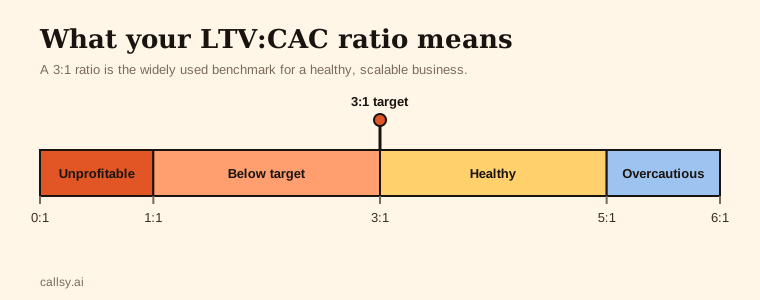
Le benchmark que presque tout le monde utilise est 3:1. À 3:1 tu es confortablement rentable sur chaque client, avec assez de marge pour financer les frais généraux et la croissance. Les paliers ci-dessous donnent la lecture rapide :
- En dessous de 1:1. Tu perds de l'argent sur chaque client acquis. Insoutenable. Corrige le CAC ou la LTV avant de monter les dépenses.
- De 1:1 à 3:1. Rentable mais juste. Souvent le signe de coûts d'acquisition élevés ou d'une rétention faible.
- Autour de 3:1. Le point d'équilibre sain et scalable.
- Au-dessus de 5:1. Souvent le signe que tu sous-investis dans la croissance et que tu pourrais te permettre d'acquérir plus agressivement.
La période de retour : l'autre moitié du tableau
Le ratio te dit si l'économie unitaire fonctionne ; la période de retour du CAC te dit combien de temps ta trésorerie est immobilisée. C'est le nombre de mois nécessaires pour récupérer le coût d'acquisition d'un client : CAC / (profit brut mensuel par client).
Un ratio solide avec un retour sur 24 mois peut quand même peser sur la trésorerie d'une petite entreprise. C'est exactement pourquoi les canaux de récupération plus rapides et à plus forte marge comptent. Récupérer un client que tu as déjà acquis ne coûte presque rien, ce qui augmente la LTV et raccourcit le retour en même temps.
Questions fréquentes
Qu'est-ce qu'un bon ratio LTV:CAC ? Environ 3:1 est le benchmark standard pour une entreprise saine et scalable. En dessous de 1:1 tu perds de l'argent par client ; au-dessus de 5:1 tu sous-investis peut-être dans la croissance.
Comment calcule-t-on la LTV ? Multiplie le panier moyen par les achats par an, par la durée de vie moyenne du client en années, par ton pourcentage de marge brute. Pour les abonnements, divise le revenu moyen par compte multiplié par la marge brute par ton taux d'attrition.
Comment calcule-t-on le CAC ? Divise toutes les dépenses de vente et marketing sur une période par le nombre de nouveaux clients acquis sur cette période. Inclus les dépenses publicitaires, les salaires, les agences et les outils.
La LTV est-elle la même chose que la CLV ? Oui. Valeur vie client et valeur vie client (CLV) sont la même métrique sous deux noms.
Comment améliorer mon ratio LTV:CAC ? Soit tu baisses le CAC, soit tu augmentes la LTV. Augmenter la LTV via la rétention et le win-back est généralement moins cher et plus rapide que réduire le coût d'acquisition, parce que tu vends à des gens qui t'ont déjà choisi une fois.