What is an AI agent for customer service?
An AI agent for customer service is software that handles a customer conversation from start to finish, on the phone or in chat, without a person in the loop. It listens or reads, works out what the customer wants, looks things up in your systems, does something about it, and closes the conversation. The part that matters is the last clause. A bot that collects a question and hands it to a human is a form with a personality, and most of the market still sells those.
The useful distinction is not chat versus voice. It is inbound versus outbound, and almost nobody writing about this category separates them.
The two jobs behind one phrase
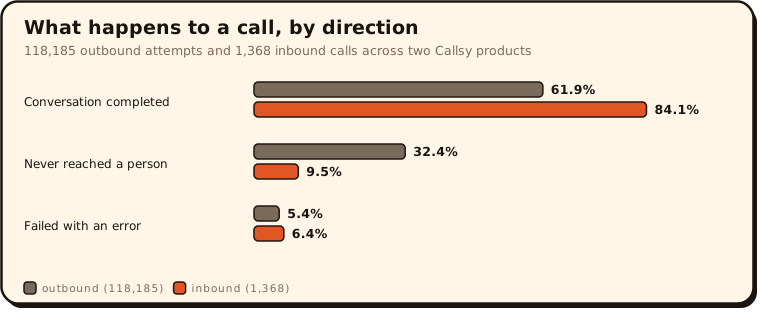
We went back through every call either Callsy product has ever placed or answered. That is 121,832 of them: 82,132 outbound cart-recovery calls from 397 Shopify stores since September 2024, 38,332 outbound calls from 166 businesses on the main platform since April 2026, and 1,368 inbound calls from 10 businesses since August 2026. The split is lopsided because an outbound campaign is easy to start and an inbound line means pointing your actual phone number at an agent, which people do more carefully.
Inbound calls completed 84.1% of the time. Across 118,185 outbound attempts, 61.9% completed. A third of outbound calls, 32.4%, never reached a person at all, against roughly one in ten inbound.
This is not a quality difference in the agent. It is the same agent. It is that someone who dials your number has already decided to talk to you, and someone you dial has not. Every published statistic about AI handling customer service inherits that difference, and almost none of them disclose which side of it they measured.
How long does an AI customer service call actually take?
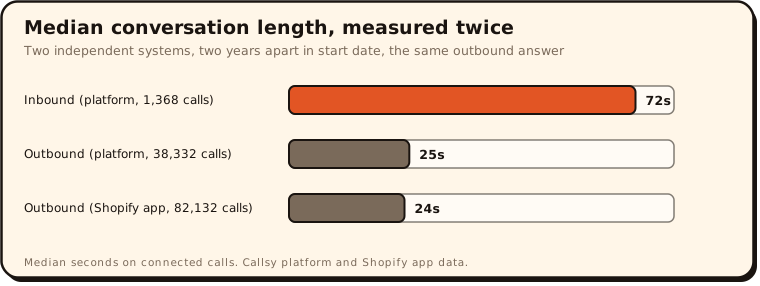
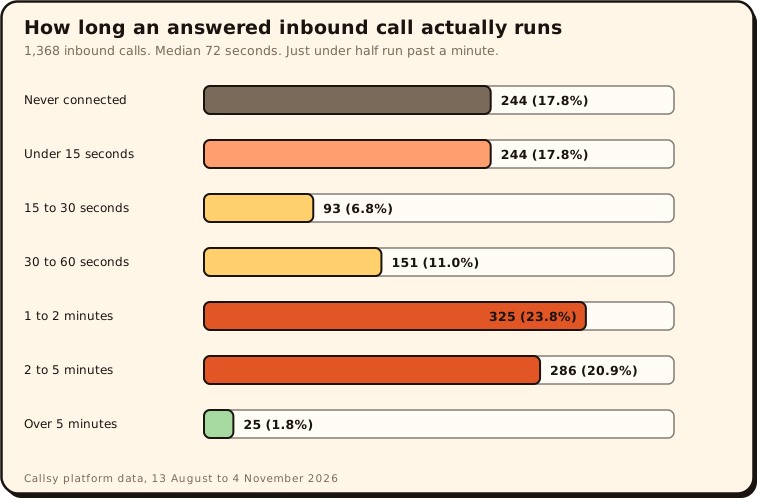
The median answered inbound call runs 72 seconds. The mean is 84.9, dragged up by a long tail. Outbound sits at 25 seconds on the platform and 24 seconds across 82,132 Shopify cart-recovery calls, which tells you most of what you need to know about what happens on an outbound call.
Underneath that median there are really three populations. Just under a fifth of inbound calls (244 of 1,368) never connect. Another fifth end inside 15 seconds, which is a wrong number, a hang-up, or a caller who wanted a human and said so. And then 46.5% run past a minute, which is a genuine conversation: a booking, a reschedule, an order question, a complaint.
Those two outbound medians, 25 seconds and 24, come from different products, different providers and start dates two years apart. Landing a second apart is the closest thing to an independent replication we have, and it is why we trust the inbound number against it.
If you are modelling cost, model the 46.5%. Per-minute pricing on a service where half the calls are under 60 seconds and a third never reach anyone is not the same as per-minute pricing on a call centre, and vendors quoting you a blended rate are usually quoting the average of a bimodal distribution.
What published resolution rates actually measure
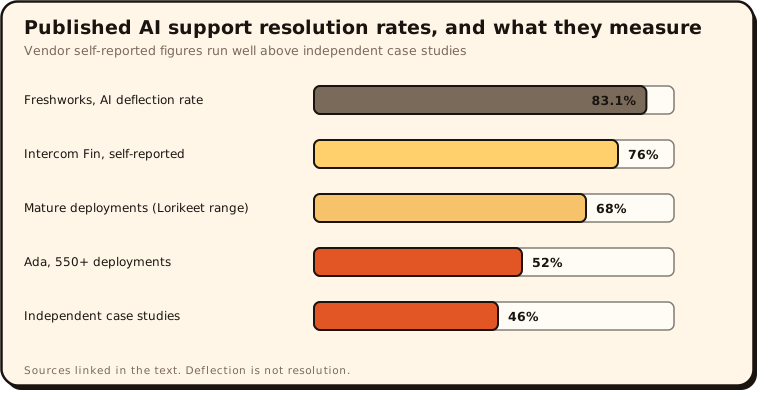
Intercom reports that its Fin agent resolves 76% of conversations end to end across 12,000 customers, up from 66% in October 2025. Ada reports about 52% across more than 550 deployments. Lorikeet's read of the market is 40 to 60% at launch and 60 to 76% once mature, and independent case studies of the same products tend to land between 42 and 50%. Gartner's forecast is that agentic AI will autonomously resolve 80% of common customer service issues by 2029, where the load-bearing word is common.
Then there is Freshworks, reporting an average AI deflection rate of 83.1%. Deflection is not resolution. Deflection means the query never reached a human, which is also what happens when a customer gives up. The gap between those two words is where most of the disagreement in published AI customer service statistics lives.
Treat 40 to 60% as the honest planning band for a new deployment and be suspicious of anything above 80% until you have read the definition. The question to ask a vendor is not what their resolution rate is. It is what counts as resolved, whether reopened conversations are subtracted, and whether abandoned sessions are in the numerator.
What breaks, in our own numbers
17.8% of inbound calls never connected. That is the number we would leave out if this were a sales page, so here is what sits behind it: carrier handoff failures, calls that arrive while a number is mid-configuration, and callers who hang up during the first ring. A further 6.4% ended in an error, which is higher than the outbound error rate of 4.2%, because an inbound call has to resolve a live context (who is this, which business, which agent) that an outbound call already has in hand before it dials.
Nobody in this category publishes that second number. We are publishing it because the honest version is more useful to someone choosing a vendor, and because an 84.1% completion rate means nothing unless you know what the other 15.9% did.
- Ask any vendor for completion rate and error rate separately, not a single success figure
- Ask whether calls that never connected are in the denominator
- Ask for the median conversation length, not the mean, because this distribution is bimodal
- Ask what happens on handoff when the agent cannot resolve something
Which AI model is best for customer service?
This is the most-asked follow-up on the query and it is close to the wrong question. On a voice call, the model is maybe a third of the experience. The rest is how fast the agent starts speaking, whether it stops when interrupted, whether it can read your calendar, and what it does when it does not know.
The thing customers notice first is latency. A pause of a second and a half before the agent answers reads as a bad line, and people talk over it. The thing they notice second is whether it can actually do anything: an agent that understands a reschedule request perfectly and cannot write to the diary has failed the call just as completely as one that misheard.
Pick on integrations and interruption handling. The underlying model is a commodity that changes every few months anyway.
How much do AI agents cost for customer service?
Advertised per-minute rates run from roughly $0.05 on developer platforms to around $0.25 on packaged products, and neither figure is the bill. The platform fee, the telephony leg, the transcription, the model calls and the integrations are usually separate lines, and the per-minute number is the smallest of them for most small businesses.
The arithmetic that matters is cost per resolved conversation, not cost per minute. Take the median conversation length, divide by your resolution rate, and add the fixed monthly fee divided by volume. At a 72 second median and a 60% resolution rate, a nominal $0.15 per minute is about $0.30 of variable cost per conversation actually resolved, before any fixed fee.
We publish a full breakdown of where the quoted rate stops matching the invoice in our AI voice agent cost guide, and the missed-call revenue calculator puts your own numbers against it.
How can AI actually improve customer service?
The honest answer from our data is narrow and specific: it answers the calls you were not answering. Inbound completion of 84.1% is not impressive against a well-staffed support desk. It is transformative against a phone that rings out at 6pm, which is the actual alternative for most businesses under fifty people.
The second thing it does is remove the queue. An AI agent has no concurrency limit worth worrying about, so the twentieth caller at 9am on Monday gets the same first-ring answer as the first. For a business whose customers call in bursts, that is worth more than any accuracy improvement.
What it does not do, on this evidence, is replace a support team. It handles the half of inbound that is a booking, a status question or a straightforward change, and it should hand the rest to a person quickly and without making them repeat themselves.
What to ask before you buy one
Most of the pages ranking for this query are vendor explainers that describe benefits. Here is the shorter version of what to actually check, assembled from running the thing.
- Inbound or outbound: which one are their published numbers from?
- Completion rate and error rate as two numbers, with the denominator defined
- Median conversation length, and what proportion run under 15 seconds
- Whether it writes to your diary, CRM or order system, or only reads
- What the handoff to a human looks like, and whether context carries across
- Whether the per-minute rate is the whole bill, and what the fixed fee buys